
Trinity B2 Reading & Writing Test: Overview, Format and Tips
B2 English Overview, Format and TipsThe Trinity ISE II (B2) Reading & Writing test is designed to assess how effectively you can understand written English and communicate your ideas in writing at B2 level.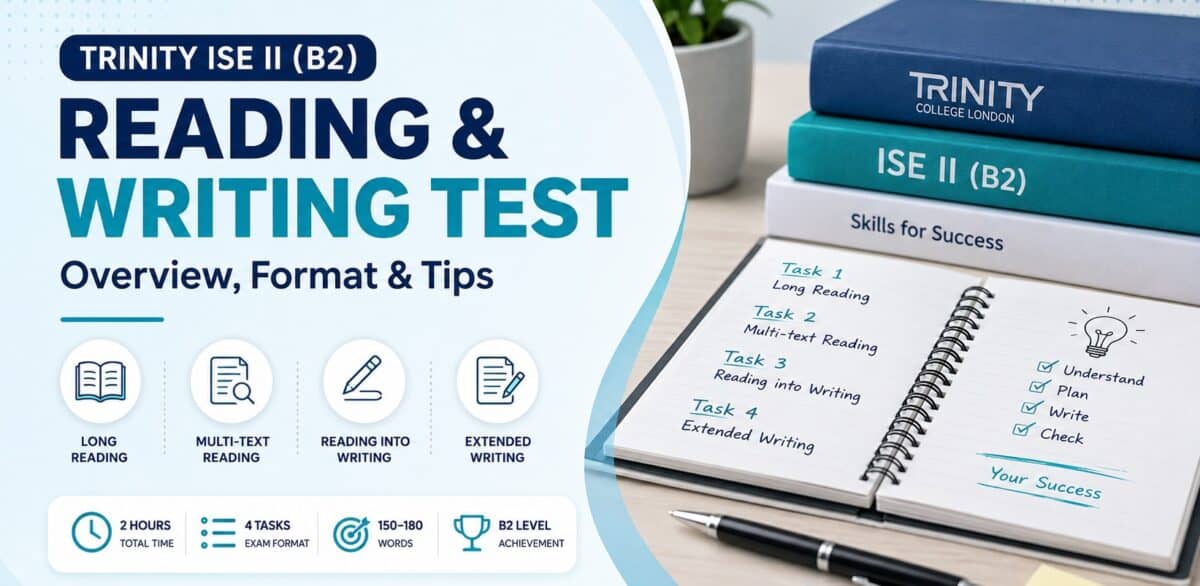
The Reading & Writing examination lasts two hours and consists of four tasks:
- Task 1 – Long Reading
- Task 2 – Multi-text Reading
- Task 3 – Reading into Writing
- Task 4 – Extended Writing
Trinity College London's official ISE II resources confirm that the B2 Reading & Writing module contains these four tasks and lasts two hours.
The key to performing well is not simply reading quickly or knowing a lot of vocabulary. You need to understand what each task is testing, manage your time and answer the question you have actually been asked.
Trinity B2 Reading & Writing Test
The Reading & Writing test lasts two hours and contains four separate tasks. Understanding the structure before exam day can make it much easier to manage your time and focus on what each task requires.
Trinity B2 Reading & Writing Test at a Glance
The examination is divided into two reading tasks and two writing tasks. Each section requires a different approach, so it is important to understand the task type rather than using the same strategy throughout the whole exam.
Long Reading
Read one longer text and answer 15 questions covering titles, true statements and sentence completion.
Multi-text Reading
Read four texts and answer questions involving matching, true statements and completing notes.
Reading into Writing
Use information from all four Task 2 texts to produce a focused written response.
Extended Writing
Write approximately 150–180 words in response to the given question and required format.
Try to spend no more than 20 minutes on each reading task. Protect the 40 minutes allocated to each writing task so that you have enough time to plan, write and check your answers.
Task 1 — Long Reading
The Long Reading task contains 15 questions based on one longer text. The questions test your ability to identify the main idea of paragraphs, recognise information that is true and locate specific words or phrases in the text.
Three Question Types
Title Matching
Choose the most appropriate title for each paragraph. There are six possible titles, but you will use only five.
True Statements
Choose the five statements that are true from a list of eight options. Look back at the text for evidence.
Sentence Completion
Complete each sentence using an exact number, word or phrase from the text, with a maximum of three words.
For title matching, don't try to understand every word. Focus on what each paragraph is mainly about.
For true statements, locate the sentence or section that confirms whether each statement is supported by the text.
For sentence completion, choose an exact word, phrase or number from the text and do not exceed three words.
Even if you are uncertain, make your best choice. Don't leave questions blank.
Task 2 — Multi-text Reading
In the Multi-text Reading task, you work with four different texts and answer 15 questions. The key skill here is being able to move efficiently between sources and identify which text contains the information you need.
Three Question Types
Multiple Matching
Choose the correct text that each question refers to. Remember that the same text can be used more than once.
True Statements
Choose five true statements from eight options. Check the four texts for evidence before deciding.
Completing Notes
Complete the notes using an exact number, word or phrase from one of the four texts. Use no more than three words.
Read the four texts quickly and identify the subject and main purpose of each one.
Think of each text in simple terms, such as “benefits”, “problems”, “research” or “personal experience”.
When answering a question, return to the relevant text and confirm the information rather than relying on memory.
Pay attention to words such as always, never, only, most, some and usually.
Reading into Writing
Use information from the four Task 2 texts to answer a writing question.
Task 3 is different from the reading questions because you need to combine information from the four texts and transform it into your own written response. The answer should be focused on the question rather than simply summarising the texts one by one.
A practical step-by-step approach
Read the question
Underline the important words and identify exactly what the question asks you to discuss or explain.
Identify every part
If the question contains several requirements, make sure your plan includes every part.
Plan your response
Use the planning space to create a quick mind map or list of the information you want to include.
Use all four texts
Your answer needs to refer to information from all four texts from Task 2.
Paraphrase
Use your own words as far as possible instead of copying sentences directly from the reading texts.
Check your work
Return to the question and check that you have answered every part, then check grammar and spelling.
Use information from all four texts, but don't simply copy them. Select relevant information, combine ideas and express them in your own words.
Extended Writing
Respond to the question using a clear, organised written response.
In Task 4, you respond directly to the Extended Writing question. Read the prompt carefully before you begin and make sure your answer follows the required format, purpose and audience.
Possible writing formats
You may need to write a descriptive, discursive or argumentative response depending on the question.
Use an appropriate tone and organise your ideas so that the article is engaging and easy to follow.
Pay attention to whether the situation requires a formal or informal style.
Follow the purpose of the genre and make your information easy for the reader to understand.
A simple writing structure
Set up the topic
Introduce the subject and make it clear what your response will discuss.
Develop your points
Give clear ideas and support them with explanations, examples or relevant details.
Finish clearly
Where appropriate, summarise your position, recommendation or main point.
Before moving on, check that you have answered every part of the question, used an appropriate style and corrected obvious grammar, spelling and punctuation mistakes.
How to Improve Your Trinity B2 Reading Skills
Success in the reading sections is not about understanding every word. You need to know how to read for different purposes and find the information required by the question.
Read for Gist
Understand the overall meaning of a paragraph or text. Ask yourself: What is this mainly about?
Read for Detail
Locate a specific fact, number, word or idea rather than reading every sentence with equal attention.
Read for Evidence
When deciding whether a statement is true, find the exact information in the text that supports your answer.
What If You Don't Know a Word?
Don't panic when you encounter unfamiliar vocabulary. First, look at the surrounding sentence and paragraph. The context may give you enough information to understand the general meaning.
Use the context
- Read the sentence around the word.
- Look at the words before and after it.
- Think about the paragraph's main idea.
- Look for examples or explanations nearby.
- Ask whether the word is actually important to the question.
Don't lose time
- Don't stop for every unfamiliar word.
- Don't try to translate the entire passage.
- Don't spend several minutes on one vocabulary item.
- Don't allow one difficult question to damage your timing.
- Don't assume every unfamiliar word is important.
Common Trinity B2 Reading & Writing Mistakes
Spending too long on reading
Trying to understand every sentence perfectly can leave you without enough time for the writing tasks.
Better approach: read for meaning first, then search for specific information when answering questions.
Leaving answers blank
If you are unsure, make your best choice rather than leaving the question unanswered.
Better approach: keep moving and return to difficult questions if time allows.
Copying Task 2 texts
Task 3 requires you to use information from the texts, but simply copying sentences does not demonstrate effective transformation.
Better approach: paraphrase and combine relevant information.
Ignoring one of the four texts
Task 3 requires you to refer to information from all four Task 2 texts.
Better approach: make a short note about each text during Task 2.
Writing too much
More words do not automatically produce a stronger answer. Focus on relevance, organisation and accuracy.
Better approach: aim for approximately 150–180 words.
Not checking your work
Small errors can be corrected if you leave enough time at the end.
Better approach: reserve the final few minutes for proofreading.
How to Prepare for the Trinity B2 Reading & Writing Test
The most effective preparation combines familiarity with the exam format, regular English practice and timed work on each task type.
Trinity B2 Reading & Writing: Final Checklist
🎯 Final Tips for the Trinity B2 Reading & Writing Test
Think of the exam as four separate tasks rather than one large two-hour test. For Task 1, focus on the main idea and specific evidence. For Task 2, learn to move efficiently between the four texts. For Task 3, combine information from all four sources and use your own words. For Task 4, answer the question directly, organise your ideas clearly and use an appropriate writing style. Most importantly, protect your time: aim for 20 minutes, 20 minutes, 40 minutes and 40 minutes.
Frequently Asked Questions
Quick answers to common questions about the Trinity B2 Reading & Writing test.
How long is the Trinity B2 Reading & Writing test?
The Trinity ISE II B2 Reading & Writing test lasts two hours and consists of four tasks: Long Reading, Multi-text Reading, Reading into Writing and Extended Writing.
How many questions are in the Trinity B2 Reading test?
Task 1 contains 15 questions and Task 2 contains another 15 questions, giving you 30 reading questions across the two reading tasks.
How long should I spend on each Trinity B2 reading task?
A useful target is 20 minutes for Task 1 and 20 minutes for Task 2. This leaves 40 minutes for Reading into Writing and 40 minutes for Extended Writing.
How many words do I need to write in Trinity B2?
Both Task 3 and Task 4 require approximately 150–180 words. Focus on answering the question fully rather than trying to write unnecessarily long answers.
Do I need to use all four texts in Reading into Writing?
Yes. Task 3 requires you to use information from the four texts in Task 2. You should use your own words as far as possible rather than simply copying from the reading texts.
What types of writing can appear in Trinity B2?
Depending on the task, you may need to write a descriptive, discursive or argumentative essay, article, formal or informal email or letter, review or report.
What should I do if I don't know a word in the reading?
Try to understand the word from its context. Look at the surrounding sentence, the paragraph's main idea and the words around the unfamiliar term. If the word is not important for answering the question, don't spend too much time on it.
Should I leave a Trinity B2 reading question blank if I'm unsure?
No. Make your best choice rather than leaving the question unanswered. Good time management is important, so avoid spending too long on one difficult question.
Ready to Prepare for Your Trinity B2 Test?
Build your confidence in Speaking, Listening, Reading and Writing with our B2 English course in East London.