
Trinity B2 Test Speaking & Listening
B2 English Overview, Format and Tips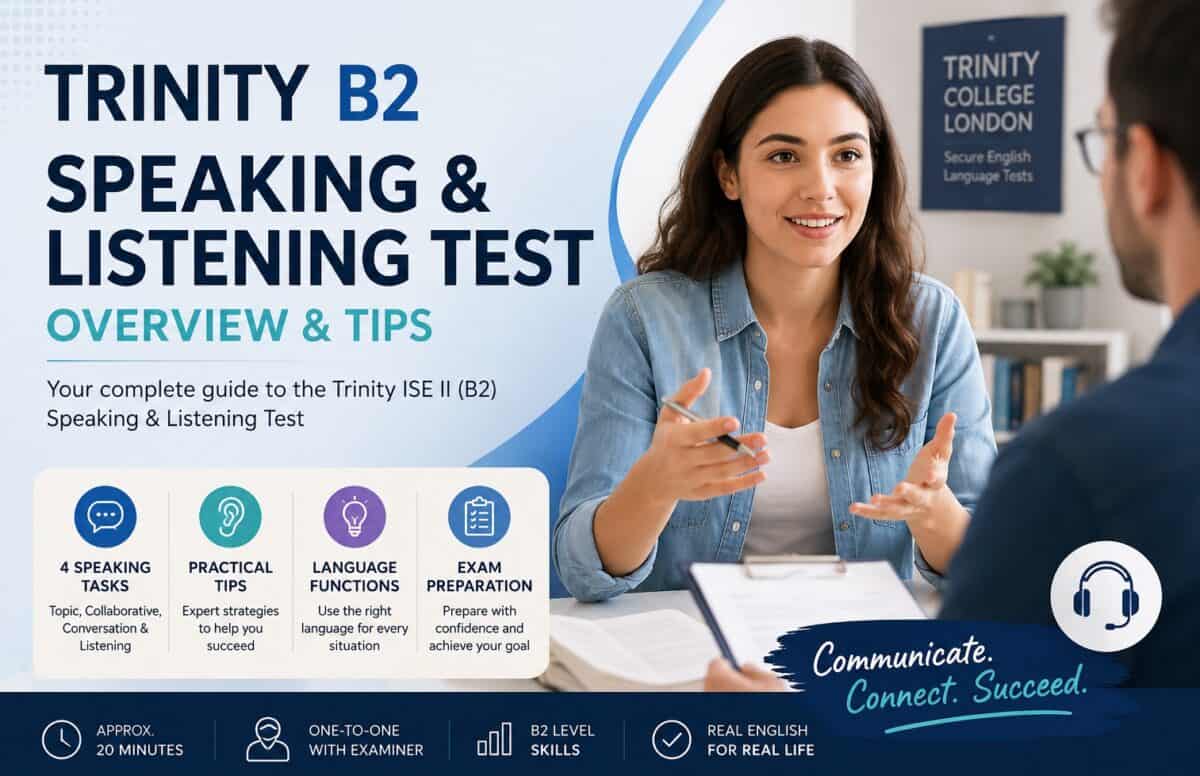
If you are preparing for the Trinity B2 test (ISE II), the Speaking & Listening exam can feel challenging because you need to do more than simply answer questions. You need to interact naturally with the examiner, express and develop your ideas, ask questions, give opinions, speculate and show that you can understand spoken English.
The good news is that the format is predictable. Once you understand what happens in each task and practise the right language functions, you can approach the exam with much greater confidence.
This guide explains the Trinity B2 Speaking & Listening test, what to expect in each part and practical tips to help you perform at B2 level.
Trinity B2 Speaking & Listening: Quick Overview
The Trinity ISE II (B2) Speaking & Listening test is a one-to-one exam with a Trinity examiner. The Speaking & Listening module takes approximately 20 minutes and consists of four tasks.
Topic
Discuss a topic you prepared before the exam.
Collaborative
Lead a discussion by asking questions and making comments.
Conversation
Discuss a subject chosen by the examiner.
Independent Listening
Listen to a recording and respond to questions.
Topic
4 minutesCollaborative
4 minutesConversation
2 minutesListening
8 minutesSome older Trinity preparation materials describe the Independent Listening task as 10 minutes. Trinity's current ISE II information gives it as 8 minutes, so candidates should use the latest official Trinity guidance when preparing.
The exam assesses your ability to communicate effectively rather than simply produce grammatically perfect English. For the Topic, Collaborative and Conversation tasks, Trinity assesses communicative effectiveness, interactive listening, language control and delivery.
What Happens in the Trinity B2 Speaking & Listening Test?
When you enter the examination room, the examiner will greet you and explain what happens. The Speaking & Listening test is conducted as a one-to-one interaction.
Try not to think of it as a formal interview where you simply answer questions. Several tasks require you to take an active role in the conversation.
Your mindset during the exam
Listen Respond Develop Ask Interact
Do not give a short answer and wait silently for the examiner to continue. At B2 level, you should demonstrate that you can keep a conversation moving.
Task 1 – Topic Discussion
Up to 4 minutesBefore the exam, you choose a topic that you are interested in and prepare to discuss it with the examiner.
Your topic could be about:
Personal subjects
- Your work
- A hobby
- An experience
- Your community
Wider subjects
- Travel or tourism
- An issue in your local area
- Education
- Technology
For example, you might choose:
You could prepare several points, such as:
- How tourism affects your area
- Advantages of tourism
- Disadvantages of tourism
- How local people benefit
- Problems caused by tourism
- What might happen in the future
- What local authorities should do
Trinity recommends preparing your topic as a discussion rather than memorising a long speech. You can bring notes, a diagram or a mind map to support your discussion.
How to prepare your Topic
A simple mind map is much better than writing a complete script.
→ Benefits
→ Problems
→ Local businesses
→ Environment
→ Future
→ Solutions
Then think about what you could say about each point.
Advantages
“One of the main advantages of tourism is that it creates jobs for local people. It also helps small businesses such as restaurants and hotels.”
Disadvantages
“On the other hand, tourism can put pressure on local services, particularly during the summer months.”
Future
“If tourism continues to increase, I think the area will need better public transport and more sustainable facilities.”
Do not memorise a four-minute speech
The examiner may ask questions or take the discussion in a slightly different direction. If you memorise everything word for word, you may struggle when the conversation changes.
Instead, prepare four or five interesting points and practise talking about them naturally.
Task 2 – Collaborative Task
Up to 4 minutesThe Collaborative task is one of the most important parts of the Trinity B2 Speaking & Listening test because you are expected to take control of the interaction.
The examiner reads a prompt, which may present a problem, dilemma or opinion. You then need to ask questions and make comments to discover more information and keep the conversation going.
This is not a task where you should simply wait for the examiner to ask you questions.
What should you do in the Collaborative task?
Take the lead
- Start the conversation.
- Ask questions.
- Give your own opinions.
- Ask for more information.
Keep it moving
- Explain your ideas.
- Agree or disagree when appropriate.
- Invite the examiner to give an opinion.
- Keep the conversation moving.
For example, if the prompt is about improving public transport, you could ask:
Then develop the conversation:
You could then ask:
This demonstrates interaction rather than isolated answers.
Useful phrases for the Collaborative task
Asking for information
- “What do you think about this?”
- “Could you tell me a little more about that?”
- “What would you suggest?”
- “Why do you think that?”
- “What do you mean by that?”
Encouraging the examiner to speak
- “What about you?”
- “Do you agree?”
- “What's your opinion?”
- “Would you consider that a good solution?”
Clarifying
- “Could you explain what you mean?”
- “Do you mean that…?”
- “Could you give me an example?”
Developing an idea
- “Another point worth considering is…”
- “This could also lead to…”
- “The main advantage would be…”
- “However, there is another side to the issue.”
Task 3 – Conversation
Up to 2 minutesIn the Conversation task, the examiner chooses a subject area and starts a short conversation with you.
ISE II Conversation subject areas
Society & values
- Society and living standards
- Personal values and ideals
Work & environment
- The world of work
- National environmental concerns
Public figures
- Public figures past and present
Because the examiner chooses the subject, you should prepare for all five areas, rather than preparing only one topic.
What does the examiner want to hear?
The B2 level expects you to do more than describe things.
- Express and develop opinions
- Explain reasons
- Highlight advantages and disadvantages
- Speculate about possibilities
- Give advice
- Agree and disagree
- Ask for further information
- Establish common ground
- Maintain a conversation
“Working from home is good.”
Try:
“I think working from home has several advantages, particularly because it gives employees more flexibility. However, it can also have disadvantages because some people may feel isolated.”
That answer gives an opinion, develops it and introduces a contrast.
Task 4 – Independent Listening
Approximately 8 minutesThe Independent Listening task is different from the speaking tasks because you are assessed on your ability to understand and respond to spoken information.
According to Trinity's current ISE II format, you listen to a recording and answer questions about it. The recording is played twice, and you may take notes during the second listening. Your notes are optional and are not assessed.
What might you need to identify?
- Main ideas
- Opinions
- Important details
- Advantages and disadvantages
- Ideas or proposals
- Information supporting an argument
How to take notes effectively
Do not try to write every word.
Instead, write keywords and short phrases.
Tourism
jobs +
local shops +
traffic -
pollution -
sustainable transport
council proposal
You could also use simple symbols:
Your notes do not need to be grammatically correct because they are there to help you remember the important information.
Trinity specifically recommends focusing on key words rather than attempting to write down everything you hear.
Listen for meaning, not every word
One of the biggest mistakes candidates make is panicking when they hear an unfamiliar word.
You do not need to understand every word.
01
What is the speaker talking about?
02
What is the main point?
03
What opinion is being expressed?
04
What are the advantages or disadvantages?
05
What examples or reasons are given?
This approach is much more useful than trying to translate the recording word by word.
The B2 Language Functions You Should Practise
A strong Trinity B2 candidate needs more than a large vocabulary. You need to demonstrate that you can use language for different communicative purposes.
Expressing and expanding opinions
- “In my opinion…”
- “I believe this is mainly because…”
- “One reason for this is…”
- “I would argue that…”
Discussing advantages and disadvantages
- “One major advantage is…”
- “The main drawback is…”
- “On the one hand…”
- “On the other hand…”
Speculating
- “It might…”
- “This could lead to…”
- “If this continues, I think…”
- “It is possible that…”
Giving advice
- “I would recommend…”
- “It would be better to…”
- “One solution would be to…”
- “The government/local council should consider…”
Agreeing and disagreeing
- “I completely agree because…”
- “That's a good point.”
- “I'm not entirely convinced by that.”
- “I see what you mean, but…”
Eliciting further information
- “Could you tell me more about that?”
- “Why do you think that?”
- “Could you give me an example?”
Establishing common ground
- “I think we both agree that…”
- “We seem to have a similar view.”
- “I agree with you to some extent.”
The important thing is not to force these phrases into every answer. Use them naturally when they help you communicate.
Top Tips for Passing the Trinity B2 Speaking & Listening Test
01. Practise speaking without memorising
Prepare ideas, vocabulary and useful phrases, but avoid memorising complete answers.
The examiner needs to hear that you can communicate spontaneously.
02. Give developed answers
Avoid one-sentence answers.
You are giving an opinion, explaining why and adding another point.
03. Ask questions
This is particularly important in the Collaborative and Conversation tasks.
Good questions demonstrate that you are listening and interacting.
04. Don't dominate without listening
Speaking a lot is not enough.
The examiner is also assessing interactive listening. Trinity's assessment criteria specifically include interactive listening alongside communicative effectiveness, language control and delivery.
Listen to what the examiner says and respond to it.
05. Don't panic about your accent
You do not need to sound like a native English speaker.
Trinity assesses how intelligible you are and does not require candidates to copy a particular English accent.
Focus on:
- Speaking clearly
- Using appropriate pronunciation
- Avoiding speaking too quickly
- Making your ideas easy to understand
06. Use linking words
B2 speakers should be able to connect ideas.
However · Although · Therefore · In addition · For example · As a result · On the other hand · In contrast · From my perspective · In my experience
07. Correct yourself calmly
Making mistakes is normal.
Do not stop speaking for a long time because of one grammatical mistake.
08. Ask the examiner to repeat something if necessary
If you do not understand a question, do not guess blindly.
“Sorry, could you explain what you mean?”
The aim is successful communication, so asking for clarification can be much better than giving an unrelated answer.
How to Prepare Your Trinity B2 Topic
A simple preparation method is to choose one topic and create a mind map.
Topic: Tourism in My Area
Advantages Disadvantages Local economy Environment Residents Future Solutions
Then prepare questions and opinions around each area.
Possible questions
- What are the benefits of tourism?
- What problems does tourism create?
- How does tourism affect local businesses?
- What would happen without tourists?
- How could tourism become more sustainable?
- What should local authorities do?
This allows you to practise discussing the subject rather than reciting a prepared speech.
Trinity provides official B2 practice activities covering the Topic, Collaborative, Conversation and Independent Listening tasks. It also provides sample listening activities, including topics such as tourism, working from home, artificial grass and cycling.
A Simple 7-Day Trinity B2 Speaking & Listening Study Plan
If your exam is approaching, you can use this simple plan.
Choose your topic
Select a topic you genuinely know about and create a mind map with four or five main points.
Practise language functions
Practise expressing opinions, advantages and disadvantages, agreement and disagreement, advice and speculation.
Collaborative practice
Take different problems or opinions and practise asking questions. Aim to keep each discussion going for four minutes.
Conversation practice
Practise the five Trinity conversation areas: society and living standards; personal values and ideals; the world of work; national environmental concerns; and public figures past and present.
Listening practice
Listen to short talks or presentations. Write only keywords and identify the main idea, opinions, reasons, advantages, disadvantages and examples.
Full speaking practice
Ask a friend, teacher or English tutor to act as the examiner. Practise the tasks under timed conditions.
Light revision
Review your topic mind map, useful expressions and common vocabulary. Do not try to learn hundreds of new phrases the night before your exam.
Common Trinity B2 Speaking Mistakes to Avoid
Giving very short answers
Problem: You answer the question but do not develop your idea.
Better: Give an opinion, reason and example.
Waiting for the examiner
Problem: You expect the examiner to ask all the questions.
Better: Ask questions and take an active role, particularly in the Collaborative task.
Memorising a speech
Problem: Your answer sounds unnatural and you may struggle if the examiner interrupts or changes direction.
Better: Prepare ideas rather than sentences.
Trying to use difficult vocabulary everywhere
Problem: You may use words incorrectly or make your speech unnatural.
Better: Use vocabulary you understand and can use accurately.
Ignoring the listening task
Problem: You spend most of your preparation time practising speaking.
Better: Practise listening to talks and identifying the main ideas, opinions and supporting details.
Speaking too quickly
Problem: Your pronunciation becomes less clear and you may make more mistakes.
Better: Speak at a comfortable pace and pause briefly between ideas.
What Level of English Do You Need for Trinity B2?
B2 corresponds to the upper-intermediate level of the Common European Framework of Reference for Languages (CEFR).
At this level, you should be able to communicate relatively independently, explain your ideas and participate in discussions about familiar and less familiar subjects.
Think communication, not perfection
For the Speaking & Listening test, this means you should focus on effective communication, not perfection.
A few mistakes will not automatically mean you have failed. What matters is whether you can communicate your meaning, interact with the examiner, use appropriate language and respond effectively.
Trinity's assessment system considers communicative effectiveness, interactive listening, language control and delivery for the three speaking tasks.
Final Trinity B2 Speaking & Listening Tips
Before entering the exam room, make sure these essentials are fresh in your mind.
- Choose a topic you genuinely enjoy discussing.
- Prepare a mind map rather than a memorised script.
- Prepare four or five strong points about your topic.
- Practise all five Conversation subject areas.
- Ask questions during the interaction.
- Give reasons for your opinions.
- Discuss both advantages and disadvantages.
- Practise speculation and advice.
- Listen carefully to the examiner.
- Ask for clarification when necessary.
- Take keywords rather than full sentences during listening.
- Do not panic when you hear an unfamiliar word.
- Speak clearly rather than trying to sound like a native speaker.
- Keep the conversation natural.
- Most importantly, communicate rather than recite.
The official Trinity resources are particularly useful because they include practice activities and sample materials for each part of the ISE II Speaking & Listening exam.
If you are taking the Trinity B2 test for a UK visa, remember that ISE II is a four-skills test covering Reading, Writing, Speaking and Listening, and the exact requirements depend on the visa or application route. Always check the current requirements for your specific application.
Frequently Asked Questions
How long is the Trinity B2 Speaking & Listening test?
The Trinity ISE II Speaking & Listening test takes approximately 20 minutes. It consists of a 4-minute Topic task, 4-minute Collaborative task, 2-minute Conversation task and approximately 8-minute Independent Listening task.
Can I choose my own topic for the Trinity B2 test?
Yes. For the Topic task, you choose a topic to prepare before the exam and discuss it with the examiner. You can bring notes, a diagram or mind map to support the discussion.
Can I memorise my Trinity B2 topic?
You can prepare your ideas and practise talking about them, but it is better not to memorise a complete speech. The Topic task is designed as a discussion, so you need to respond naturally to the examiner.
What subjects can come up in the Trinity B2 Conversation task?
The five ISE II Conversation subject areas are Society and living standards; Personal values and ideals; The world of work; National environmental concerns; and Public figures past and present.
What language functions are tested at Trinity B2?
The key functions include initiating and maintaining a conversation, expressing and expanding opinions, discussing advantages and disadvantages, speculating, giving advice, agreeing and disagreeing, eliciting further information and establishing common ground.
Can I take notes during the Independent Listening task?
Yes. Trinity's current guidance says you may take notes during the second playing of the recording. Your notes are optional and are not assessed.
Do I need a British accent to pass Trinity B2?
No. Trinity assesses how intelligible you are and does not require candidates to copy a particular English accent.
What is the best way to prepare for Trinity B2 Speaking & Listening?
The most effective preparation combines timed practice of all four tasks with regular speaking and listening practice. Focus particularly on developing opinions, asking questions, keeping conversations going and understanding the main ideas in spoken English.
Ready to Prepare for Your Trinity B2 Test?
Build your confidence in Speaking, Listening, Reading and Writing with our B2 English course in East London.