Government Funded Courses for Mature Students
The Ultimate UK Guide for Mature Student Finance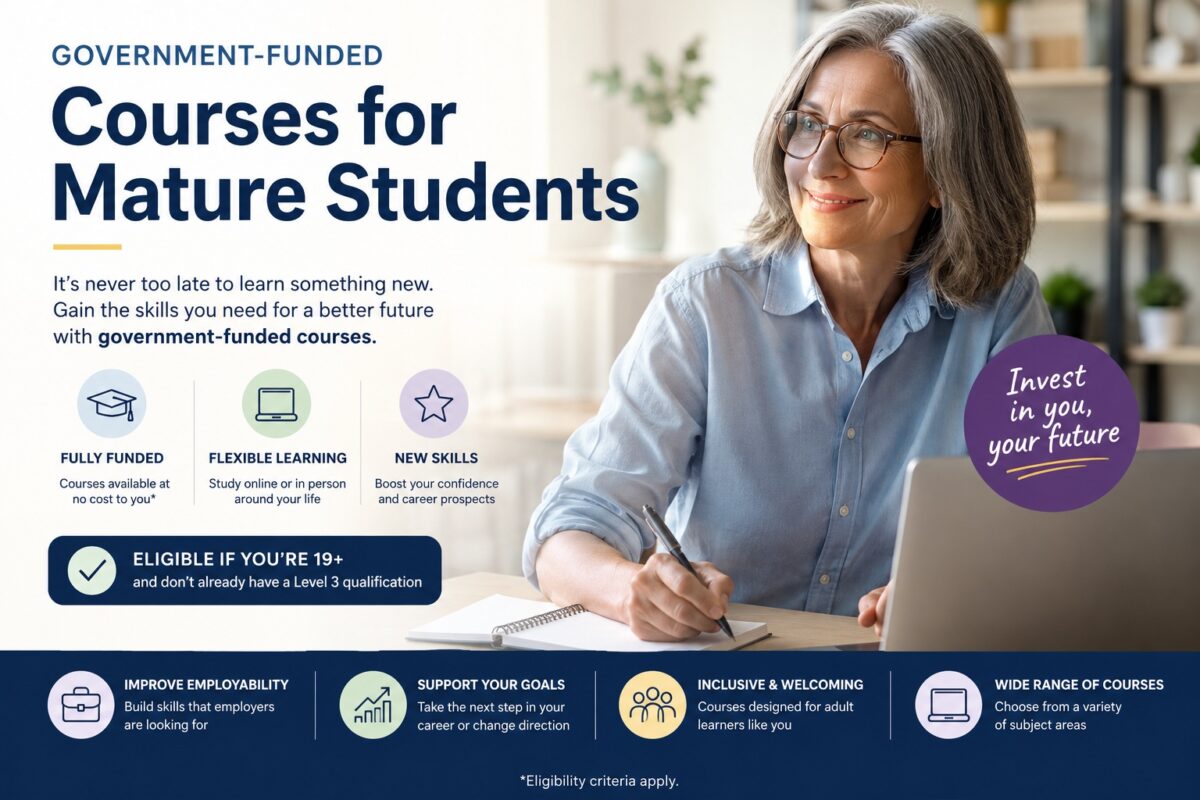
Returning to education as an adult can feel incredibly daunting. The Problem? Many mature individuals feel trapped in low-wage roles, lacking the specific certifications required to advance, but simultaneously lacking the disposable income to pay for private training.
The Agitation?
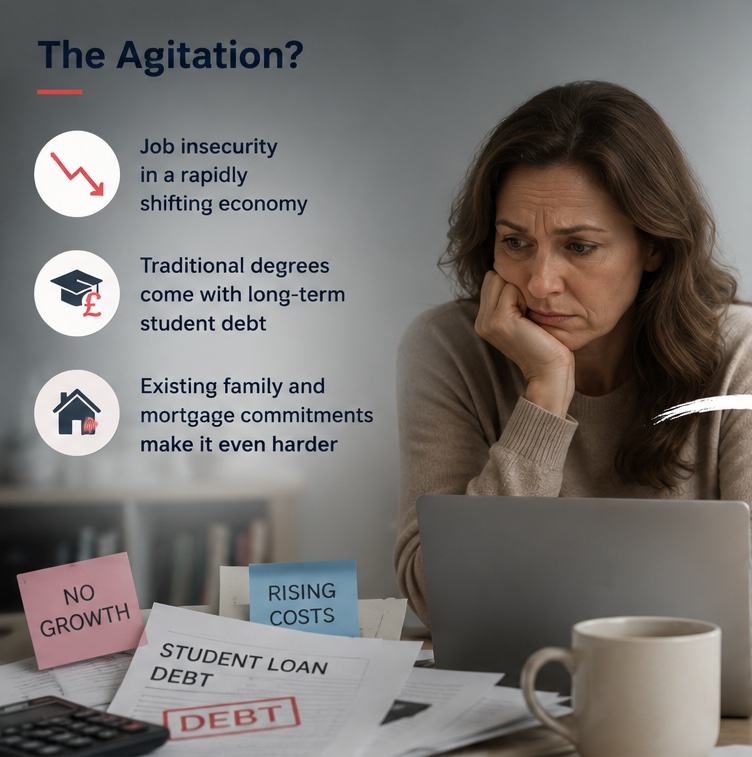
Remaining stagnant in a rapidly shifting economy leads to job insecurity. At the same time, traditional university routes carry the heavy burden of long-term student debt, which many adults simply cannot afford to take on alongside their existing family and mortgage commitments.
The Solution
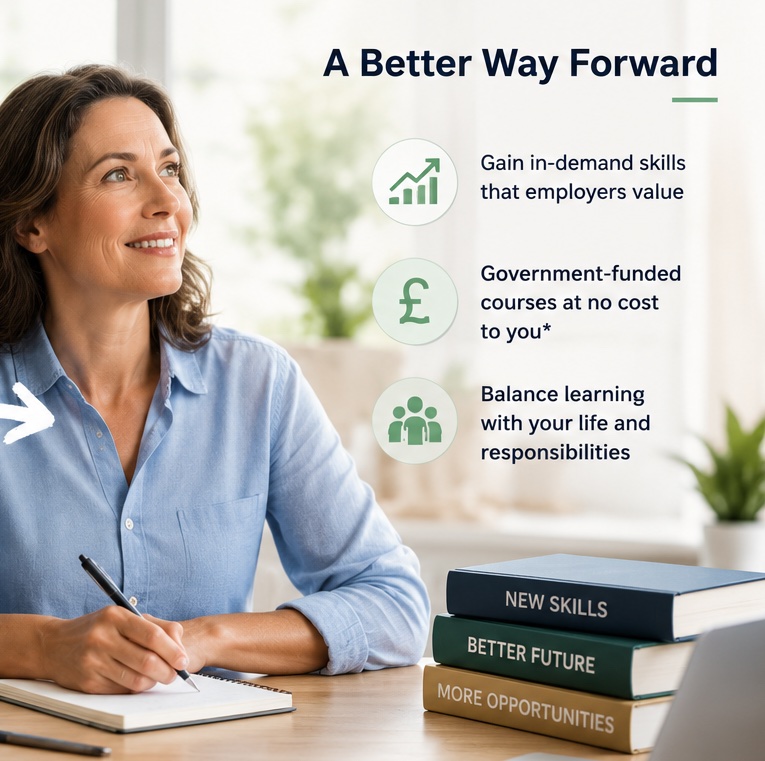
You don't necessarily need to take out a massive loan to upskill. There is a vast array of government funded courses for mature students designed to help you retrain, completely free of charge. From the Adult Education Budget to the upcoming Lifelong Learning Entitlement, the UK government provides fully funded, zero-cost courses specifically tailored for adult learners.
Understanding Adult Education Funding in the UK
To navigate your options, you first need to understand where the funding comes from and how it works. These funds are not paid directly to you into your bank account; instead, they are paid directly to registered training providers and colleges to cover your course fees.
What is the Adult Education Budget (AEB)?
The Adult Education Budget (AEB) is a major UK government-funded initiative designed to provide financial support for adults who want to broaden their skills, improve their employability, or explore an entirely new career path. The government uses the AEB to help boost the economy, reduce unemployment, and promote social mobility across the country. It supports a wide range of courses, from basic skills to technical subjects in health and social care, business administration, and IT.
The Adult Skills Fund (ASF) Explained
Operating alongside the AEB is the Adult Skills Fund (ASF). The ASF is nationally managed in non-devolved regions by the Department for Education and funds the delivery of education and training for learners aged 19 and over. Whether you want a short, discreet course to build confidence or a larger qualification to secure a promotion, the ASF is the primary mechanism colleges use to make these courses free for you.
Eligibility: Can You Get a Free Government Course?
A common misconception is that free education ends at 18. However, eligibility for adult funding is remarkably straightforward if you meet certain basic criteria.
Age and Income Thresholds Explained
To qualify for a free government course under these main schemes, you generally need to meet the following parameters:
- Age: You must be aged 19 or older.
- Income: The government will typically pay your course fees in full if you are currently unemployed, or if you earn below £25,750 a year. (Note: The national Department for Education earnings threshold is sometimes listed as £25,000, but this can fluctuate based on your specific location ).
If you receive welfare, there is more good news. Many Universal Credit claimants are permitted to take full-time training for up to 16 weeks while continuing to seamlessly claim their benefits.
Regional Variations and Devolved Funding Rules
It is important to note that depending on where you live, there might be slightly different rules about the maximum amount you can earn to qualify for a free course. Devolved regions (like Greater London or Greater Manchester) manage their own localized budgets, so you should always check the exact earnings threshold with your local course provider.
Available Qualifications: What Can You Actually Study?
The goal of these funding streams is to get adults into high-demand jobs. Therefore, the available courses are heavily focused on practical, employable skills.
Free Courses for Jobs (Level 3 Qualifications)
The "Free Courses for Jobs" programme is a flagship government initiative enabling adult learners to access Level 3 qualifications for free. A Level 3 qualification is academically equivalent to an A-Level or an advanced technical diploma.
You can study a Level 3 qualification in sectors that desperately need skilled workers, including:
- Accounting and finance
- Early years and childcare
- Digital and IT
- Engineering and manufacturing technologies
- Health and social care
This program is specifically targeted at individuals who do not already possess a Level 3 qualification, or those who meet the low-wage criteria, providing a massive opportunity to dramatically improve your earning potential.
Skills Bootcamps and Level 2 Certificates
If you are not ready for a Level 3 course, there are plenty of foundational options. The government fully funds Level 2 qualifications (equivalent to GCSEs) in foundational sectors like construction, manufacturing, and engineering. There are also incredibly popular Level 2 certificates available in subjects like Children's Mental Health, Mental Health First Aid, and Understanding Autism.
If you are looking for rapid retraining, Skills Bootcamps are free, flexible courses lasting up to 16 weeks. They are designed in partnership with employers to help you develop specific new skills—from digital coding to health and social care—with the goal of securing an interview at the end of the bootcamp.
The Multiply Scheme for Numeracy
If numbers make you anxious, you aren't alone. The Multiply scheme offers free courses specifically designed to improve adult maths and numeracy skills, which is often a major barrier for mature learners returning to the workplace.
(Image Suggestion: Comparison chart showing Free Courses for Jobs Level 3 qualifications versus Level 2 certificates for adult learners. Alt text: Comparison chart showing free courses for jobs level 3 qualifications versus level 2 certificates for adult learners.)
The 2026/2027 Paradigm Shift: Lifelong Learning Entitlement (LLE)
The way adult education is funded is about to undergo a massive revolution. Beginning in September 2026 for courses and modules starting from January 2027 onwards, the government is launching the Lifelong Learning Entitlement (LLE).
Under the new LLE system, eligible learners will be able to access a tuition fee loan entitlement of up to £39,160—which is equal to four years of study based on current maximum tuition fees.
This isn't just traditional student finance; it is entirely modernised for adult life:
- Modular Learning: Rather than only funding full academic years, the LLE allows you to apply for funding for individual, shorter modules. You can dip in and out of education, upgrading your skills exactly when your career demands it over your working life.
- Retraining Freedom: The LLE removes the strict "equivalent or lower qualification" (ELQ) restrictions, meaning even if you already hold a degree, you can use residual funding to completely retrain and reskill in a new industry.
- Maintenance Support: If you are studying eligible courses in person, you will also be able to apply for a maintenance loan to help with your daily living costs.
Any learner who completes an LLE-funded module will receive a standardised transcript at the end of their study, allowing you to stack your credentials as you go.
How to Apply for Government Funded Training
Applying for adult education is less complex than applying for a traditional university degree. Follow these three steps to secure your spot.
Step 1: Check Your Eligibility Status
Review your annual income to see if you fall below the £25,750 threshold (or your local equivalent). Determine whether you are looking for a Level 2 certificate, a Level 3 Free Course for Jobs, or a 16-week Skills Bootcamp.
Step 2: Find a Registered Training Provider
You can't apply for these funds via a personal bank account. You must find a college or elite training provider that has an active government contract. (External Link Suggestion: Use the official National Careers Service course finder to see which courses are available for free in your local area.)
Step 3: Complete Your Enrollment Securely
Contact the college or training provider directly. Confirm they offer the qualification you're interested in, verify your age and residency, and apply. If accepted on a funded course, you will not be asked to pay a course fee.
Frequently Asked Questions About Adult Funding
No. AEB funding is a non-repayable grant utilised by registered training providers to cover the cost of your education. Unlike a traditional student loan, you do not have to pay this money back.
Currently, most free courses (like Level 2 certificates or Skills Bootcamps) do not come with maintenance loans for living costs, though you may get help with travel or childcare. However, when the Lifelong Learning Entitlement (LLE) launches for courses starting in January 2027, eligible learners studying in-person modules will be able to apply for maintenance support.
While universities often classify a mature student as anyone starting an undergraduate degree aged 21 or over 1, adult skills funding works differently. To be eligible for the AEB, the ASF, or the Free Courses for Jobs schemes, you generally just need to be aged 19 or older.